HOW TO: .

Experience genealogy, family history activities, family photos and pedigree charts while searching for family connections and collections.
Showing posts with label Davies. Show all posts

Wednesday, November 14, 2012

Caroline McMurray Davies

I found this short bio on my grandmother- I don't know what it was written for, but it is just a short, concise piece:

Caroline McMurray was the 9th child of James S. McMurray and Sarah Orr. She was born on march 11, 1902 in Orton, Alberta, Canada. Her parents and seven siblings moved from Idaho in march.  It was cold and windy, they had no house, and lived in a tent for a few weeks.  Being very windy in March many times her parents and older brothers would stand outside and hold down the tent poles.

Carrie, as she was called, also had a younger sister named Lila. They were the only ones born in Canada.

When Carrie was nine her mother died of a rare disease. Lila was only four months old. Carrie was very sad and lonesome. Her older sisters helped take care of her and little Lila. Before her mother died, Carrie would stand at her side with a fan to help keep the flies from bothering her.

She attended school to sixth grade. She lived with some of her older siblings to help take care of their children. Late she worked for several different families helping with housework.  While she was doing that kind of work she met George Davies and they were married.

About 18 months after George died in 1957 she attendend Nursing School in Calgary and became a successful Nursing aid and worked at three different hospitals until she retired.

She died June 1, 1981 after being ill with Parkinson's disease.

Saturday, November 10, 2012

Saturday's Story...


Thoughts . . . . Caroline McMurray 


Alberta, Canada

Happiness does not just happen; you have to work really hard for it, and still it comes in its own time.

In 1909, when Caroline McMurray was a young girl of seven, she saw her mother die from errasipitus. She remembered fanning her mother to keep the flies off her up in her bedroom in the days before she died.  Her little sister, Lila was 4 months old, so she really missed having a mom, as did the four older brothers and four older sisters.

After a while(1914) her dad married a young girl from England just two years, who was to be the new stepmother. There was lots of work to do marrying into a family with so many children, and she made them all work hard.

She didn't teach, instead just yelled at the kids to get the work done. Carrie would have loved to be taught how to make bread, grow a garden, keep a tidy English home and take care of the chickens, but instead she resented Elizabeth trying to take her mother's place and wanted to get away.

She wasn't very nice to the kids, so Carrie quit school early and went to stay and help out at some of her older brother's homes.  Eventually she felt like she had worn out her welcome and that she needed a new place to go.


. . . Carrie McMurray - Working

After staying at her different brother's homes and having the opportunity to see different ways of doing things she was feeling rather grown-up and felt she was ready to be out on her own.

Growing up in southern Alberta there were not  many jobs available for a young girl who wanted to earn some money. Many girls hired themselves out as a helper to a farmer's wife. A hired girl could be the one taking care of the children, or doing the laundry, helping with cooking or even taking care of the animals.  They could usually count on making about one dollar a week.  During this time a dollar of cash money was worth a lot.  It meant they could use the money for the necessities of life instead of going without or using credit. No one ever really wanted to go into debt because there was too much chance that they would not have the money to pay when it came due.

Carrie got a job on the cook wagon for a threshing crew.  She had to provide three meals a day for a bunch of hungry men.  This was really hard work, but she learned a great deal and then was ready for another new adventure.

The next opportunity/adventure came in the chance to work on the Davies farm located east of Claresholm in the Starlight District in southern Alberta. The work on that farm was just as hard as at my own home, but the Davies boys were all so handsome: George, Ivan, Glen, Charlie, and Victor. the older sister, Janie had moved away and little Mary was too young to help.  Mrs. Davies really needed help.  the boys were all big enough to hlep, but they were always our helping with the farm, so she really needed my help.  i certainly never dreamed that one day she would be my mother-in-law.  Maybe she knew, and that was why she was so nice to me. She was kind and patient and made sure I knew how to fix all the family favorites. She taught me many different ways to serve potatoes, and how to make a nice flaky pie crust so I could make a chicken pot pie or a fruit pie.

 . . . more about Carrie & George

When George and Carrie Davies moved to their own farm it was their great adventure. They bought two sections of land - there is 640 acres to a section.  He was going to be a dry-land farmer and grow wheat. (as a dry-land farmer you count on rain to water your crops)

The house was two miles south and five miles west of Carmangay. They said the house faced east, but actually east was the direction they came out of the house because they came out the kitchen door. The house was small, but there was a barn with a fenced corral, and a shed and a chicken coop.

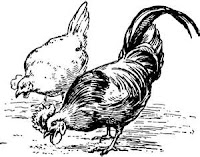
Carrie was very excited about the chicken coop.  George told her that she could sell any eggs over what they needed  and use the money any way she wanted. She would also be able to sell the extra cream and butter.
Another opportunity for Carrie to earn some cash money was to trap and kill gophers, the government paid a penny for each gopher tail.

Looking off her back porch Carrie could see the chicken coop about half a block away - she called the chickens "her girls".

She made plans for a garden down the west side of the house, along the edge of the road.  She was going to plant beans, peas, cucumbers, beets, carrots, corn, dill weed and lots of potatoes. George would dig a potato pit which would to store the potatoes. A potato pit is dug down deep and the pit is then lined with boards and a there is a ladder for climbing down into the pit.  The pit is covered by boards and will store many bags of potatoes to keep them fed through the long, Canadian  winter.

Carrie really enjoyed working in the garden early on the summer days, before it got too hot. After working in the garden for a few hours she would come into the house and make breakfast for George.  His favorite breakfast was a steak, bread and milk gravy; but most times his breakfast was hot cereal, usually oatmeal and hot chocolate.

Saturday, October 27, 2012

William George Davies

George Davies --- by Caroline Davies

This was page 405 of an unidentified book.  I only have a copy of this page.  But since my grandma wrote it, I have to include it, even without the source.
Russian thistle
The George Davies family came to Carmangay district in April, 1928.  We had two daughters, Shirley Maxine, two years old, and Glenna Elaine, three months. We bought the Stanley Robinson farm of three quarters, seven and one-half miles west and south of Carmangay. It was a real struggle the first few years -- so much wind and the soil was so light, so had lots of soil drifting and I guess that's why they called it the dirty 30's.
1930's tractor
We farmed with horses for a number of years, later we were able to buy another quarter section joining our south quarter from Jack Gillespie. We were able to sell our horses (although many tears were shed) for a second-hand tractor and later a Johnson blade and that was the answer to soil drifting.


Grasshoppers were terrible for a number of years and took so much of our time spreading bait. Russian thistles were also a menace and we used to burn them in the spring.
grasshopper

We had to haul out drinking water in a stone-boat in barrels, baling it by hand for our own use and the livestock, later getting a pump.

gopher
Gophers were plentiful too -- the municipality offered one cent a tail so we bought traps and I trapped for days.  Earl Blaine was teaching school at Prairieville and boarded at our place -- he used to shoot the gophers and let me have their tails.  I made $7.50  -- so that was quiet something!

We took in the Christmas concerts at all schools for miles around and also went over to the Starline every two weeks to dance to Mackie Russell's orchestra.  We didn't have a babysitter those days so we took the girls tucked in the bottom of the buggy.

Glenna went to Burwash School when she was five years old to help keep the school open as they needed six pupils.  Miss Hazel McAllister was the teacher.  Pupils at that time were Pearl Russel, Eileen and Phyllis  Simmons, Helen Anderson, Shirley and Glenna. After the school closed the girls went to Ryckman.  Josie Hubka was teacher. They went to Rykeman for a number of years and then were vanned to Carmangay.

During the country school days dances were held in one school or the other every week, and those were the best times ever.  Everyone was welcome. Ladies brought lunch and everyone enjoyed themselves.  We had the best stampedes at Carmangay for years and people came from many miles away. Agricultural Fairs were an annual event, also Bobbie Burns concerts.

coal bucket
On January 31, 1939 our only son, Murray George came to our house and our family was complete.  We hauled coal from east of Carmangay and Champion as we had only coal stoves and furnaces.  What a treat when we could finally afford a wind-charger, 32 volt electric plant.  We got plenty of wind and could really enjoy some of the comforts of living.  Had my first power washer when I was 46 years old. Later we got Calgary Power. First telephone June 4, 1945.

Thursday, October 25, 2012

Diphtheria in the 1930's


"In the early 20th century diphtheria outbreaks evoked fear around the world. Until the 1930s it was one of the most common killers of children in Canada and the United States."

I found this quote on the site from the Canadian Medical Association and talked to my mom to see if she knew anyone who had diphtheria. It jogged her memory and she told me that she remembered hearing that her father, William George Davies had had diphtheria when he was a child and even missed a year of school to recover. Her dad was very close lipped about many things so she had not heard this from him, but it was shared from her Aunt Sis (her dad's sister). She wished now that she had asked more questions.

Canadian Medical Association

Wednesday, October 10, 2012

William John Davies


On November 25, 1896 William John Davies and Sarah Amanda Nowlin were united in marriage. They farmed in the Shelton district in Idaho, their nearest town being Idaho Falls, Idaho.  Mr. Davies was born in Wyoming in 1872 and Mrs. Davies was born in Utah in 1878.  Their were five children born to them in Idaho, Janie, George, Ivan, Glenn and Charlie.
In March 1908, Will decided to sell his farm and come along to Canada along with several other families, brother and sisters of Will and Sarah.  In early March all their belongings, such as machinery, household effects, livestock and, yes, the family, were loaded onto a train and headed out for Canada.
However, upon arriving in Great Falls, Montana, they found all their livestock had to go through inspection and had to be put through disinfection, so there was a delay of several days.
All the women, with the children, went to a hotel.  There were five or six women and somewhere around eighteen children in one hotel, so the children had a hilarious time, lots of noise and excitement with lots of mad patrons in the hotel.
One man was so mad because George Davies and Leland Nowlin knocked on this door; he opened the door and said he would kill them if they didn’t stop, so they went out on the street looking for a policeman.  While they were looking they ran into Charles Nowlin’s family, who had left a few days later and were looking for the group. They returned to the hotel with the boys.
In a few days however, it was discovered that Charlie Davies, seven months and Harold Nowlin, four months, had chicken pox. The babies were wrapped in their shawls, and all the women and children left for Claresholm by train with Jabus Nowlin, as leader and protector.

Upon arriving in Claresholm, the group was met by a brother of Sarah and Ernest Nowlin, from Carmangay, so the two men with the women and eighteen children marched from the station to the Wilton Hotel, with all who were able, carrying bags, suitcases, etc. As we went along the street, we heard people say, “There goes a bishop and his family”

 William and Sarah moved onto a farm in the Starline district with their five children and in 1910 Victor was added to the family and in 1916 Mary was born. Mary died in young childhood at the age of eleven and a half.

William Davies bought and farmed several parcels of land in the Starline district and was a very successful farmer from 1908 until his death in 1935.  Sarah and sons Glenn and Charlie farmed a few years, then Sarah moved to Claresholm, then on Christmas day in 1945 she passed away after several years of failing health

Janie married Harry Taitinger, a son of Nick Taitinger. George married Carrie McMurray of Cardston. Ivan married Rachel Lepard of Claresholm.  glen remained unmarried.  Charlie was married to Zelpha Newby of Lethbridge and victor married Mabel Johnson of Claresholm. There were nineteen grandchildren.

Sunday, September 16, 2012

Caroline McMurray Davies

This wonderful lady is my grandmother. All us grand-kids called her Grandma Davies, or sometimes just "Gram". She made the best sugar cookies!  Seeing her picture brings memories and stories to my mind.  Family pictures need to come out of the box so we can have our memories...